Comcast: To Xfinity and Beyond!
Showing posts with label media. Show all posts
Showing posts with label media. Show all posts
Monday, December 12, 2011

Sunday, December 11, 2011
Digital Media Network Analysis and Lessons Learned
Network Analysis
Please enjoy the following presentation on our network analysis of the Digital Media and Entertainment industry. We manipulated the network diagrams to better demonstrate the ties between layers in our stack model, which we found to deliver some great insights into the complexity of this industry.
A class assignment in Networks
View more presentations from efhansen.
Lessons Learned
Given that the Digital Media industry stack has changed significantly over the last five years, with new players in OTT services, new avenues of distribution (digital v. physical), and a new platform layer that is ever evolving, the landscape and subsequent industry stack is sure to change again in the next five years.
Here are some lessons that we learned throughout the semester:
- The digital media industry is in constant flux. With each new innovation or change, the entire industry shifts (Hulu is a great example of this). Firms in the industry must always be looking forward and be willing to take calculated risks in order to keep up.
- Networks and studios are developing both vertically and horizontally to cover all bases as the industry transforms. We anticipate a move to extradite themselves from the ventures that do not prove to be effective and over the next few years shift back down to their core capabilities. Tech giants Amazon, Apple, and Google may have an advantage, as their core capabilities tend to naturally span horizontally across multiple layers.
- Incorporation of analytics and customization of content to mobile devices will certainly continue to shape this industry.
- Content producers are joining the online streaming game, and will likely stop licensing (or increase license fees) with 3rd party OTT services once they have built the requisite capabilities (and/or user base) to offer content directly to consumers.
- The network for the industry is still missing a few links between hardware and content producers. Networks and studios should develop their own streaming capabilities in order to protect and improve margins on their original and library content.
- Defining capabilities, industry networks, and stack models is more of an art (design) than a science, since different choices must be made depending on the level from which it is viewed (such as the firm or industry)
Sunday, December 4, 2011
Boxee Live TV: Game-Changer? Or the next Google-TV?
http://www.boxee.tv/live
So Boxee has been around for a while, but this new device seems revolutionary. Boxee has long been known as an alternative form of media/entertainment delivery, connecting the internet to your TV and allowing you to utilize the hard drive space of your computer as a DVR to record shows online and watch later. But with Boxee Live TV, you actually bypass the internet and can record HD-quality TV from an HD-antenna, connected directly from the antenna to your Boxee Box through this USB device.
The one thing this device falls short on in terms of completely cutting the cable cord is sports entertainment. While the device would allow the recording of over-the-air sports in HD, which is huge, it still doesn't offer access to ESPN and other premium sports networks, which currently are available only through cable subscriptions (with the exception of ESPN3.com, which is available to certain cable internet subscribers). In my experience with GoogleTV, and I think this is true for Boxee Box (Linux , ESPN3.com blocks the browsers on those devices, based either on the browser's user agent or the lack of a flash player. For sports fans, the Boxee LiveTV doesn't provide an answer, but if you don't care about sports, this is an intriguing value proposition.
Unfortunately the USB device ($49) looks like it's only compatible with the Boxee Box by D-Link, which runs about $179, but for a total of $230 you could cut your cable bill and still get HD-quality shows, saving hundreds of dollars in the long run. It's certainly making me rethink my recent purchase of a $249 HD laptop as an entertainment center to stream current network content, although the sports viewing aspect is still a big one for me. Thankfully Costco has a 90-day return policy on their electronics, in case I change my mind. :)
We all know the cable cord-cutting revolution has begun, in my opinion this device is a game-changer.
Friday, November 4, 2011
Google Ponders Pay-TV Business
And so it begins...
The Wall Street Journal reported this morning that Google is looking to crash the cable TV party, which the Digital Media and Entertainment group predicted in our view of the 2016 landscape for the sector, that software companies such as Google would soon become a force in the home video market. While Google has launched (rather unsuccessfully) the Google TV platform, they lacked the deals with major distribution companies like Walt Disney (ABC), CBS, NBC Universal (owned by Comcast), Time Warner, and others, to really compete in the offering of traditional TV service to consumers. This move would certainly address those concerns. What's interesting in this story is that Google recently hired a former cable-TV executive (Jeremy Stern) in September to hold talks with media companies on possible distribution deals. By relying on an insider, Google is clearly serious about entering this business, even though they continue to downplay their efforts.
As reported in the article, it will be interesting to see how Google fits this move into its YouTube strategy of offering free, ad-supported online channels, which it is currently rolling out with deals with celebrities and production companies. Could YouTube be their platform for delivering traditional TV content?
I also think their choice of Kansas City as the test market for this service is very intriguing. This market is reportedly serviced by Time Warner Cable, Dish Network, and DirecTV. Comcast doesn't appear to have a foothold in this market, so Google looks to have chosen a region where the nation's leading cable provider cannot put up much of a fight.
Monday, October 31, 2011
Digital Media and Entertainment: Comcast

A LEADER ON THE BRINK OF DISRUPTION
Company Overview: Comcast is the leading cable provider of video, internet, and phone services in the U.S., and after their recent acquisition of NBC Universal, they are also a global leader in the development, production, and distribution of media and entertainment. But despite their leadership position, Comcast is definitely on the defensive, understanding that the disruption of digital technology is approaching. While they have made several moves in recent years, acquiring NBC Universal and partnering with software and technology companies, they also have to deal with the internal issues centered around customer service and reputation in an increasingly service-oriented digital world.
Expansion into the Mobile Space: Comcast has recently introduced services that expand their business model into mobile, including the introduction of Xfinity TV and Xfinity 2go. Xfinity TV is a mobile application available for free on iPad and Android tablets that offers current subscribers the opportunity to watch TV shows and movies anywhere and anytime they want. Xfinity TV may also later serve as a platform for other applications, as they look to partner with Samsung and incorporate the Xfinity TV in with the Samsung Smart TV. Xfinity 2go is a mobile broadband wireless solution that allows customers to take the internet with them wherever they go, at 3G and 4G speeds courtesy of their partnership with Clearwire and Sprint Nextel.
Strategic Acquisitions: Comcast recently acquired broadcast network and production studio NBC Universal from GE in 2011. This mega-merger sets the stage for other large-scale deals for content on behalf of competitors in the internet delivery of entertainment. Comcast was faced with increased competition from Netflix, Vudu, Hulu, and other internet streaming companies, and their response was to vertically integrate content into their service offering. Only time will tell whether this was the right move for Comcast to make, but what is certain is that Comcast is
Partnerships to Prepare for What’s Next: Comcast has made several strategic partnership deals in the past several years in anticipation of the digital transformation of the media and entertainment industry. By partnering with Samsung, Clearwire, Sprint Nextel, Microsoft, Skype, and Facebook, Comcast is looking to maintain their leadership position by teaming up with technology companies in the face of this digital transformation. This offers some insight into the fact that Comcast knows the future of Hollywood, like many other digitally transformed industries in recent years, will go through Silicon Valley.
Please click here to view the full report.
Friday, October 28, 2011
Google TV Updates
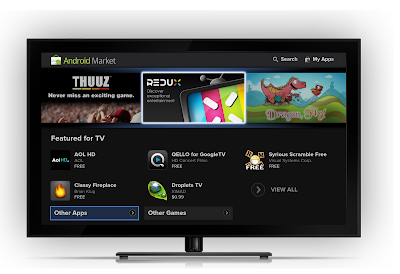
I was reading about the Google TV updates and the discussions are squarely at the center of what we have been examining in our course. It is about platforms and apps. It is about rethinking the TV architecture and not look at simply overlaying search on the existing architecture but to form linkages with chipset manufacturers to evolve TV from a standalone consumer electronics device to one that is at its core, a computer (just as the discussions we had on the automotive sector). It is about thinking Android as the OS for TV (just as Apple iOS driving Apple TV).
-
It will be interesting to see what they do with Google +
--
Look forward to your thoughts and discussions..
-
It will be interesting to see what they do with Google +
--
Look forward to your thoughts and discussions..
Subscribe to:
Posts (Atom)