The promise of Healthcare Transformation through digital technology is exciting but full of uncertainty. I predict that analytics will be most valued by the companies that pay for healthcare costs, rather than by the individuals who stand to benefit.
Verisk sells analytics products and services to companies to help these insurance payers and buyers minimize uncertainty, understand risks, and reduce costs. This focus allows Verisk Health to enjoy many strategic advantages but they face a threat of new entrants from start-ups who could pool and aggregate EMRs based on customers’ opt-in. Another threat is that when EMRs become ubiquitous, positive demand-side network effects could disrupt Verisk’s position.
Verisk should push the edge to the consumer to deepen lock-in with current customers and create value for new customers. Rather than marketing their product to consumers, Verisk would offer added B2C functionality through B2B clients. By adding this new value, Verisk’s clients’ patients and employees would demand continued service with Verisk.
Showing posts with label healthcare. Show all posts
Showing posts with label healthcare. Show all posts
Thursday, December 15, 2011


Monday, December 12, 2011
Allscripts Capabilities
http://prezi.com/cqmzkgs0iwsg/allscripts-capabilities/
Above are a few slides about capabilities at Allscripts. Allscripts is currently the largest provider of practice management and electronic medical record technologies with over 180,000 providers on their platform. They have a reputation for being innovative in their design of offering integrates solutions for clinical, financial and administrative functions.
In order to remain competitive, I think that Allscripts needs to expand their customer base to include smaller hospitals and private practices. To do this, they will need to embrace modularity and customer flexibility, allowing customers to choose just the services they want, rather than the entire EMR system. Giving customers a pay-as-you-go model will allow organizations to use Allscripts without the large capital investment that is currently necessary.
I also think that Allscripts should push the edge out to the patient. Currently Allscripts views healthcare providers as their customers, but value can be added by bringing the healthcare platform to the patient. Legislation and trends in the industry are demanding a more patient-centric approach. This doesn't just mean hospitals; it means IT companies too.
Sunday, December 11, 2011
Microsoft Health Solutions Group - Capabilities Analysis
In order to create a better system design, Microsoft needs to understand the layers in the
Health sector and in a sense, define the layers to suit the information flow. As shown in the presentation below, it is important for Microsoft to understand the key stake holders and also factor in the global delivery and support which will be a key to success with lots of information flow across geographies resulting from frequent migration of people between countries. At every layer, Microsoft needs to build capability to define a key control point and focus on defining and driving the layer with that capability.
The Healthsector Information system is most certainly moving towards being a two sided market. Microsoft will need to build its capabilities in two delivery channels. B2B with the customers being major Hospitals, Insurance companies and the Life Sciences organizations. On the other hand, Once these capabilities are built, It can build capabilities to monetize its B2B capabilities by extending it to B2C channels by targeting the actual patients. The key capabilities are going to be in terms of Technology for B2B and in terms of Process definition in terms of B2C channels.
For B2B channels, Microsoft needs to build its data management capabilities and also build its capabilities in terms of data security and Access Management
For the B2C channels, It is important that Microsoft defines specific processes in terms of App development. Support on Windows or a proprietary robust operating system and also the process for app selection, SDK delivery will be critical. In terms of the end users, it will be important to monitor the devices on which the apps are being installed in order to ensure that the backend data security and other capabilities are delivered optimally.
Please visit our site for a comprehensive analysis of the industry and the different firms.
http://healthsector-714.weebly.com/index.html
EMR Growth rate
This short article agrees with what I posted in a previous blog. The EMR is rapidly growing.
EMR market value was $15.7 billion in 2010 and its growth rate was 10% in 2009 and increased to 13.6% in 2010.
This can be considered, by all means, an astonishing growth rate. Yet, much less than what was previously expected.
The article predicts that the growth rate will rapidly increase in the nearby future.
http://www.fierceemr.com/story/emr-market-expected-increase-growth/2011-03-03
EMR market value was $15.7 billion in 2010 and its growth rate was 10% in 2009 and increased to 13.6% in 2010.
This can be considered, by all means, an astonishing growth rate. Yet, much less than what was previously expected.
The article predicts that the growth rate will rapidly increase in the nearby future.
http://www.fierceemr.com/story/emr-market-expected-increase-growth/2011-03-03
Some basics in HIT
Since the late 1990’s, healthcare delivery organizations have undergone major initiatives to adopt health information technology (HIT). These initiatives have significant potential to improve patient safety, organizational efficiency and patient satisfaction. As of 2009 however, only 2% of non-federal hospitals had a comprehensive electronic health record (EHR), with another 7.6% using a basic EHR. The EHRs are most commonly used for electronic viewing of labs, reports, and images. In addition, one in five hospitals reported a fully implemented computerized order entry and clinical decision support.
There has been a large amount of legislation recently to foster widespread use of HIT. Between 2005 and 2008, a total of 168 pieces of HIT related legislation were passed by state governments. In addition, the Health Information Technology Economic and Clinical Health Act (HITECH) of the American Recovery and Reinvestment Act (ARRA) of 2009 is providing unprecedented opportunities to expand HIT efforts through grants, loans and financial assistance programs. The legislation also mandates “meaningful use” of an EHR.
Despite the opportunities and support, many hospitals struggle to implement HIT. Inadequate capital is the most common barrier to adoption in hospitals. Other reasons include unclear ROI, maintenance cost, physician resistance and inadequate IT staff. Cloud computing, which has grown in popularity in other industries, could provide a way for healthcare delivery organizations to overcome these barriers.
Monday, December 5, 2011
Healthcare Industry Network Diagram
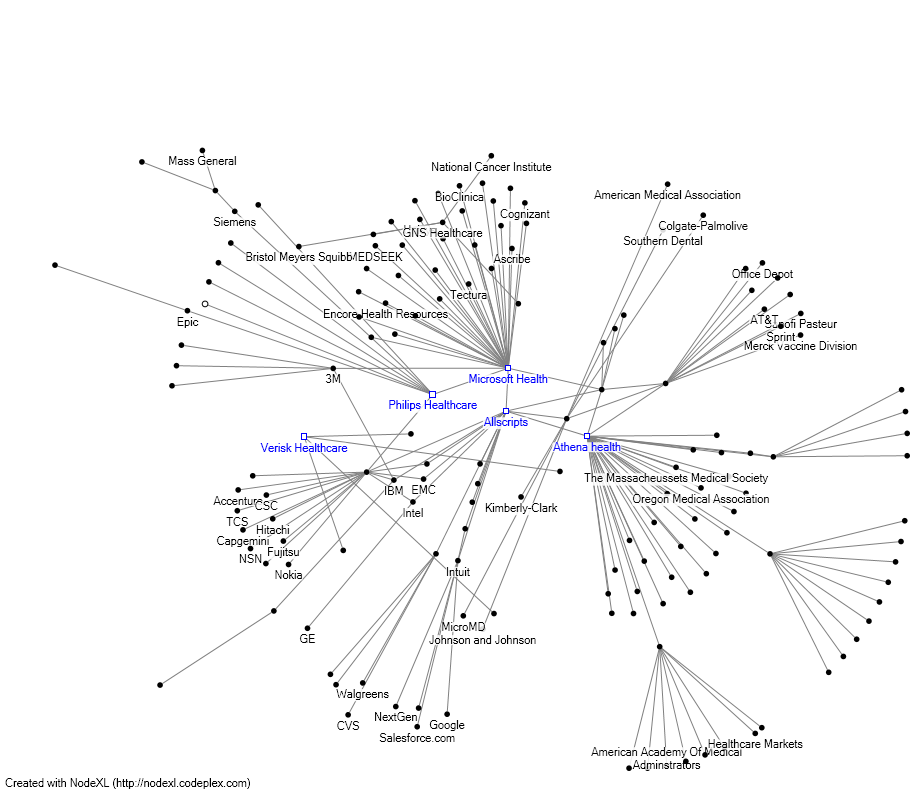
Here is the Network Diagram for the firms that we are analyzing in the healthcare industry. The firms that we focused on are in blue.
First off, it is worth noting that the five companies (Versik Healthcare, Philips Healthcare, Microsoft Health, Allscripts an AthenaHealth) are from different subsectors of the industry, including EMRs, analytics, and medical devices. This makes for a fragmented diagram. The multiple offshoots with few connections also indicate that the healthcare industry in general is not well connected through strategic partnerships. This offers many opportunities as the industry matures into a networked economy. For example, EMR providers may want to form partnerships with payers so they can provide decision support to their customers, and also absorb the analytics layer which we discussed previously.
Tuesday, November 1, 2011
AthenaHealth Network

Exhibit 1: AthenaHealth Balance sheet

Exhibit 2: AthenaHealth Income Statement


Exhibit 4: Overview of Athena's extensive Network Connections
AthenaHealth
Background:
AthenaHealth offers an integrated practice management, physician billing and electronic health record services. The company’s financial data shows a 30.2% revenue growth and a 34% increase in stock holder’s equity in 2010. Both indices have been growing for the past five years. (Exhibits 1 and 2)
The company is offering cloud based business and clinical services for physicians and practitioners. Service offerings are based on web native practice management, EHR software, a continuously updated payer knowledge- based and integrated back- office service operations. Clients are operating in 47 different states and in the District of Columbia.
Its main products are:
· Athena Collector: Athena’s physician billing and practice management service.
· Athena Clinical: Certified electronic health records service offerings.
· Athena Communicator: Web based service for managing various patient communications.
· Athena Collector: Athena’s physician billing and practice management service.
· Athena Clinical: Certified electronic health records service offerings.
· Athena Communicator: Web based service for managing various patient communications.
Current position in the sector:
Although there are several definitions for the market of healthcare information technology, the total market was, approximately, 39.5$ billion in 2008 and is projected to grow to 54.8$ billion by 2014. In 2010, Athena Health generated revenues of 245.5$ M and the estimated market, for its services, was about 28.4$ billions. Each of its products has its own position in the market. For example, Athena Collector was ranked first or second in several ambulatory and billing scheduling categories.
Analysis of the current position should be associated with some insights about the competitors. Most of the competition comes from locally installed software to manage revenue and clinical cycle workflow in the different clinics. Competitors include:
· GE Healthcare: with 17 billion in sales in 2009
· Allscripts-Misys Healthcare Solutions
· Siemens medical solution.
· Cerner Corporation.
All these firms offer either revenue cycle management “RCM” or EHR or both. In addition, they offer devices and related medical products. There are some other pure healthcare information technology firms like:
· Eclipsys
· Quality systems
Current map of network:
Athena’s business model is based on playing an intermediary role between the different players on the industry including; providers, distributors, healthcare information technology vendors, group purchasing organizations, healthcare consultants and accountants, healthcare service organizations, societies associations, physician organizations and healthcare content partners.
This network diagram (Exhibits 3 and 4) shows Athena’s interactions with some of its partners. It gives an idea about this complicated network. It is worth knowing that 31,675 medical providers are living in Athena and the number is, constantly, increasing. For example, two new providers joined Athena’s network in the 20th of October.
AthenaHealth, which lies in the middle of this complicated network diagram, which includes 31 partnerships and strategic alliances, uses its relations to exert more control over its value chain and to offer more convenience to its customers in the era of smart devices and cloud computing.

:
Monday, October 31, 2011
Microsoft Health Solutions Group
Bio-Informatics Industry
Bio-Informatics industry has a very broad definition. While it can be associated with the IT infrastructure and applications for the entire healthcare value chain from drug discovery to delivery and efficacy analysis and management, Bio-Informatics has also been increasingly associated with projects like the Genomics. At its broadest, bioinformatics is the application of information technologies and sciences to the organization, management, mining and use of life-sciences information. (Rasmussen, March 2005).Bio-Informatics can be seen as an enabler to all levels of the healthcare value chain starting from Lifesciences, pharmaceuticals to providers.
Microsoft Health Solutions Microsoft Health Solutions looks provides digital solutions across three major healthcare areas
Amalga HIS is a state-of-the-art, fully integrated hospital information system which provides rich integration among a hospital’s front- and back-office modules, giving clinicians and administrators access to information within and across departments.
The major goal of Amalga is to connect information from different sources within a Hospital. It helps view data as patient centric than source centric (like financial data, clinical data, etc). With a patient centric data management, the patient can interface with Amalga through Microsoft Health Vault. It provides a more holistic view the patient data and also provides for tracking the patients history.
Microsoft Amalga : Firms in the network Since Amalga delves into the different facets of healthcare delivery management through an IT offering, Microsoft HSG has had to built relationships with a wide variety of companies. This includes Hospitals (for early adoption), IT Vendors( For developing different modules of the Application Suite) and also Bio-pharma (who use Amalga for clinical trial management and drug efficacy monitoring).

Sunday, October 30, 2011
Company Overview - Allscripts

Allscripts is a leading provider of practice management (PM) and electronic medical record (EMR) technologies. The company has been growing, with $704.5M in revenue during 2010[i], which was an increase of 28.5% since 2009. The company is the largest EMR provider in terms of number of physicians, with 180,000 physicians using an Allscripts product[ii].
The company leads in market share across acute, ambulatory and post-acute medical services, with a breadth of product offerings for many organizations ranging from large medical centers to private practices. These products include[iii]:
· Enterprise EMR and PM
o The Enterprise suite is a clinical software solution for large hospital systems and academic medical centers. The EMR is specifically designed to improve physician productivity using tablets, handheld devices or desktop workstations. The PM streamlines the administrative capabilities or the organization.
· Professional EMR and PM
o The Professional suite is similar to the Enterprise offering, however, it is targeted towards small to mid-sized physician groups
· Allscripts MyWay
o This product allows small physician groups to choose from a variety of hosted services in order to use just the services that are most beneficial to their practice.
· Allscripts Remote
o This makes information from the EHR available on any mobile device while preserving privacy and security.
· Allscripts Document Management
o The Document Management service bridges the gap for technology adoption by scanning and filling previously used hard copies.
· Allscripts Patient Kiosk
o This is the first kiosk developed by an EMR vendor intended for patient use.
In developing and distributing these products, Allscripts has entered strategic alliances with several companies, in particular Intuit, Cisco, Henry Schein and Cardinal Health. The network diagram above shows some of these important relationships.
Allscripts has striven to be an innovative company. The open architecture has allowed third-party applications to be developed for specialty areas of care. They seek to build a platform that is flexible and allows for integrated solutions for a variety of settings. In addition, they use their customers as a collaborative community to get feedback to guide development of future solutions. With a history of successful implementations across the US and a culture of innovation, Allscripts is set up to maintain their status as a leading EMR vendor.
[i] Allscripts-Misys Healthcare Solutions, Inc. Data Monitor Report, Aug 12, 1010.
[ii] A Connected Community of Health. Investor Presentation, www.allscripts.com, Sept 2011.
[iii] MDRX 10-K, Allscripts Annual Report, July 27, 2010.
Friday, October 28, 2011
Health Information Technology - A Description of the Sector Landscape
The Health Information Technology Sector has many components. We are looking specifically at EMRs, Informatics, Analytics and Devices. By analyzing the current state and trends, we can predict what each of these pieces of the Health IT will look like five years down the road.
EMR
In the past, health data that is collected during care was recorded on paper. EMRs offer immense opportunities to improve patient care at the point of delivery by using this data and changing typical workflow. Adoption, however, has been slow because of barriers including cost, lack of expertise or technical knowledge and problems with interoperability.
With recent legislation, however, there is a major shift with financial incentives for healthcare organization that are able to attain “Meaningful Use”. There has also been a trend to address complicated reimbursement issues using data entered into the EMR. Many EMR companies have also, in an effort to improve efficiency in healthcare delivery, are offering mobile services.
In the next five years, we will see significantly better adoption of EMRs. EMR companies will compete on how their product address associated issues such as efficiency and reimbursement. In addition, EMR companies will begin using cloud services. Patient data will have the capability of be entered on mobile device, either by the patient or a provider. The reimbursement cycle will be sped up as hospitals have more information and use that as power over insurance companies.
Informatics
Clinical data includes data collected throughout the drug development lifecycle, starting with the R&D. This includes data about clinical trial management, pharmacovigilance both before and after drug launch and data in the hospital information systems. Historically, this data has been in paper form. Paper-based data collection has multiple pitfalls including the fact that it is extremely hard to correlate and make sense of data. There are also challenges for the FDA in terms of validating data and finalizing approvals.
One of the major shifts in the digital era has been the electronic information systems. Data today is collected from multiple sources and stored in data bases across the world. There are enough infrastructures, not just to store the humongous amount of data, but also to normalize the data and gain insights. With redundant systems making this data fail-safe, cloud infrastructures have enabled real-time access to data by all stake holders.
While aggregating and normalizing data from conventional sources including biopharma, CROs, providers and insurers pose challenges currently, the future could be defined in terms of a shift in patient control of data. Given the sensitivity of the data, it is only fair that the patient has enough control on both access of the data and data entry itself. For example, in order to minimize human intervention, chip implants in humans (which is already history) could gain more momentum in terms of personal health data governance and monitoring.
Analytics
Currently analytics are used to realize cost savings for medical payers. Predictive models are implemented by insurance providers to identify fraud and to estimate future costs for more accurate planning and risk reductions. The digitization of historical, present and future medical data is creating the availability of “Big Data.” Less than 20% of medical delivery practices are currently able to conduct clinical decision support.
In the next 5 years analytics will be a capability to enable clinical decision support to reduce medical costs associated with time, errors, and inventory. Cloud computing, mobile technologies and government regulation imply more data will be available and accessible anytime anywhere. These trends suggest that analytics may enable personal preventative health opportunities.
Conclusion
Overall, the industry will gain momentum in the next five years. Incentives for greater EMR adoption through the Affordable Care Act will spur adoption. Use of technology to increase privacy will improve informatics. Analytics will be used to drive decision-making, which has largely not been done in healthcare. All of these forces together will increase the influence of the healthcare information technology sector.
Thursday, October 27, 2011
Credit Scores 2.0
Fair Isaac, long known for the analytical FICO credit score, is turning their data analytics skills towards the health sector. I think the concept is interesting, given the predictive nature of even the simplest financial transactions, but I certainly share the concern about using this kind of data for determining insurance rates. It definitely breaks down some major information asymmetry barriers, but is it for the better? What do you think?
Saturday, October 22, 2011
The Untimely Death of Google Health
This past summer Google announced that it would be retiring Google Health. This happened at a time when the healthcare industry is struggling with issues of interoperability and creating Electronic Health Records (EHR). Many medical centers, individual hospitals and ambulatory care centers are well on their way to implementing their own Electronic Medical Records (EMR) and meeting “Meaningful Use” criteria as established by the HITECH Act. Without Google, who is going to create an EHR?
First, let’s take a step back and clarify the difference between an EHR and an EMR. While the acronyms are often used interchangeable, there is a technical difference. An EMR is a digital version of clinical care data. It is a patient record generated by information collected at the point of care, either given by the patient (i.e. current medications, subjective complaints) or by diagnosis and treatments (i.e. radiologic tests, doctors’ observations). An EHR focuses on the total health of a patient, going outside of the treating healthcare organization. An EHR can be managed by clinicians and staff at more than one healthcare organization. Better yet, an EHR can be accessed and managed by the patient.
Having a comprehensive EHR would be very beneficial for patient care. Suppose you are a patient at Newton-Wellesley Hospital. You have a record there, so they know your medical history. You get in a car wreck in downtown Boston and are rushed to the nearest ER. Luckily it is Mass General. Like Newton-Wellesley, they are part of Partners Healthcare, so your EMR can be accessed. Now supposed you get in a car wreck in New York and are rushed to the nearest ER. They don’t know anything about you and because of HIPAA, Newton-Wellesley is very limited in the information they can tell the ER in New York. An EHR would solve this problem.
But who is going to create an EHR? Individual medical providers don’t have the incentive as they each as well on their way with their own EMR. Companies that design and sell EMRs don’t have the incentive to make their products interoperable because that allows competitors in. Regulators are unlikely to mandate a standard in our capitalist economy. Google was headed the right direction, but was unsuccessful. This is a two-sided network problem that is up for grabs now.
Personally, I don’t think we will ever have a completely interoperable EHR. We will have better transmission of data between EMRs in the next five years. I also think that many more people will carry around some sort of card/ bracelet/USB that allows their medical data to be uploaded into anyone’s EMR. While this is not reaching a status of EHR, it will increase probabilities of successful medical care for those who are specifically concerned or invested in their health. I think only a small portion of Americans would take an active step to carry their data with them, but for those who do, we will be able to increase quality and quantity of life.
Friday, October 21, 2011
KPCB Internet Trends 2011
Mary Meeker is at it again.
For an update to the top 10 mobile trends slideshow that we read prior to beginning this semester, please see this slide show! Also you can watch a youtube video of Mary present the slides if you have 20 minutes to spare...
Takeaways:
For Healthcare: Mary's analysis on dismal the US Income statement looks if it were a company, with medicare and medicaid entitlement spending threatening to bankrupt our economy.
Financial Services: Mobile payments and revenue collections is skyrocketing
Gaming: Slide 39: reveals an inflection point where last just last quarter time spent on social media sites surpassed search engines.
KPCB Internet Trends (2011)
For an update to the top 10 mobile trends slideshow that we read prior to beginning this semester, please see this slide show! Also you can watch a youtube video of Mary present the slides if you have 20 minutes to spare...
Takeaways:
For Healthcare: Mary's analysis on dismal the US Income statement looks if it were a company, with medicare and medicaid entitlement spending threatening to bankrupt our economy.
Financial Services: Mobile payments and revenue collections is skyrocketing
Gaming: Slide 39: reveals an inflection point where last just last quarter time spent on social media sites surpassed search engines.
KPCB Internet Trends (2011)
Tuesday, October 11, 2011
Healthcare value chain
Given the complexity of the healthcare industry, it is a bit complicated to devise a value chain based stack model for the industry. This in part stems from the fact that the information flow is across different layers and not linear. We try to visualize the industry in two perspectives. First, based on care and second, based on Information flow.
Care Stack:
As far as care is concerned, the first step in the process will be the discovery of drugs through biological / molecular research. This research is then taken forward by the Bio-pharma companies. Medical devices such as Diagnostic devices, Information recording devices (ECG), etc can also be seen in this layer of the stack. This is then passed on to the patients through the providers. The position of the payers could be a bit complicated since they cannot be visualized as the consumers of the service or care. However, they play a critical role in facilitating the care delivery to the patients. Thus, the stack can be visualized as below.

Information Stack:
Having tried to understand the industry from the care delivery perspective, we tried to map the information flow in the industry. The firms we have chosen fit into multiple layers on this stack. However, we would be concentrating on products specific to one or more layers in the stack.

Monday, September 26, 2011
Information Players in the Healthcare Industry
 Here is one view of an industry map of the Healthcare industry. Because of the many linkages that exist, we see the potential for disruption coming from the players that best use Technology to create and capture value.
Our team will examine companies who are positioned to offer Software and Analytics capabilities. Specifically:
| Allscripts | (Katy Perkins) |
| Athena Health | (Nader Mousa) |
| Microsoft | (Wishwas Mohan) |
| Verisk | (Eli Mather) |
Additionally non-profit institutions have a cause and effect relationship with potential disruptions. Therefore, we will also explore the analytics capabilities of
| MassHealth. | (Chris Glenn) |
Do you agree with our view of the industry? Can you think of other companies that are positioned to enter or exit the industry? Do you think incumbency or capability will win out in the next 5 years?
Wednesday, September 21, 2011
Foldit Gamers Solve Riddle of HIV Enzyme within 3 weeks
I came across this article from Scientific American that represents the intersection of technology, gaming and healthcare. Foldit harnesses the power of crowds to solve 3-D puzzles of protein folding with the goal of treating diseases.  This latest solution that gamers achieved in 3 weeks had stumped researchers for a decade! It will help prevent the reproduction of HIV

http://www.scientificamerican.com/article.cfm?id=foldit-gamers-solve-riddle

Subscribe to:
Posts (Atom)