PG&E needs to embrace digital technology as a way to engage their customers. This is important because it solves two problems.
First, demand for electricity is increasing and customers don't want more transmission lines to be built near their homes. PG&E can use the technology that SmartMeters provide in order to implement time of use programs that will incentivize customers to use less energy during periods of high demand.
Second, customers often have inefficient behavior that is causing an unstable grid. By partnering with Nest Learning Thermostat, PG&E can use technology to influence consumer behavior.
More details can be found in these slides.
Showing posts with label Energy. Show all posts
Showing posts with label Energy. Show all posts
Monday, December 12, 2011

Thursday, December 8, 2011
Energy Sector Data Analytics
As we mentioned in our previous analysis, one of the key benefits of the Smart Grid, beyond its 2-way communication ability, is the vast amounts of data about usage it will provide. The problem is, what do we do with all that information? If we think about, in the near future, every electric outlet or piece of equipment connected to an electric outlet within a house will be able to communicate back to the utility how much energy it uses, and how and when it uses it. If we multiply this by the number of times a measurement can be made (and the more often this is done, the better), then by the number of houses in a city or a region and then we merge this data with all the data coming from other cities and regions, we will have an enormous quantity of data, that not only needs to be transported and stored, but also, and more importantly, analyzed.
According to Pike Research, the yearly worldwide spending on data analytics for the Smart Grid will reach $4.2B by 2015:
According to Pike Research, the yearly worldwide spending on data analytics for the Smart Grid will reach $4.2B by 2015:
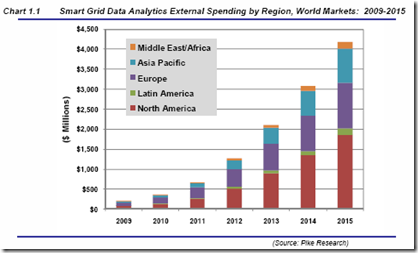
Although these are big numbers, there won’t be space for everybody. Big players like SAS and IBM will tend to buy smaller companies to complement their offering, while smaller players will either devote their efforts to focus in niche applications, or will join forces to create a new player. Whatever the outcome, one thing is clear: data analytics will be one of the pillars for the Smart Grid.
Monday, December 5, 2011

Sunday, December 4, 2011
Smart grid data analytics market will be worth $4.2bn by 2015
 Pike Research published a report last week analysing the market for smart grid data analytics. The report concluded that the associated software and services will represent one of the largest growth opportunities in the utility sector over the next few years
Wednesday, October 12, 2011
Lessons from Microsoft & Apple Applied to Energy
I’ve been struggling to find a way to connect the lessons learned from Microsoft and Apple to the energy company I chose for our project (PG&E, a utility in California). In class, Professor Venkatraman mentioned that vertical integration is giving way to horizontal layers with specialized capabilities and that winning requires dominating a layer and connecting across layers. As far as I can tell, PG&E is fighting this and is doing the opposite. The company is involved in almost every aspect of the energy industry from power generation to metering to energy efficiency consulting. I don’t believe they are leading the sector in any of these efforts, which leads me to believe that they haven’t “won” in the way discussed in class.
A large part of this is due to the fact that PG&E, like other utilities, essentially has a regulated monopoly over their region so perhaps some of the same rules don’t apply. They don’t necessarily need to dominate their layer because they don’t seem to face a great deal of competition. However, with the increasing number of Independent Service Operators participating in the market and local initiatives (like this one) aiming to give residents more options when it comes to power generation, it would be wise of PG&E to look at the lessons that can be learned from Microsoft and Apple. There may come a time when PG&E doesn’t have the government regulated “edge” over their competitors and unless they narrow their focus and excel at certain capabilities, they could potentially fall behind.
Subscribe to:
Posts (Atom)